In My Father's House: Africa in the Philosophy of Culture by Kwame Anthony Appiah
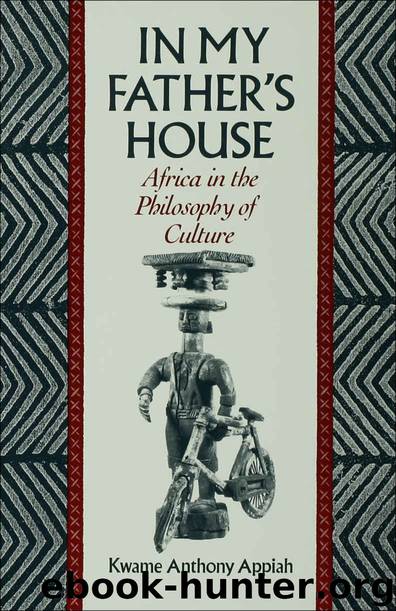
Author:Kwame Anthony Appiah [Appiah, Kwame Anthony]
Language: eng
Format: azw3
Publisher: Oxford University Press
Published: 1993-05-27T04:00:00+00:00
SEVEN
The Postcolonial and The Postmodern
You were called Bimbircokak
And all was well that way
You have become Victor-Emile-Louis-Henri-Joseph
Which
So far as I recall
Does not reflect your kinship with
Rockefeller.1
YAMBO OUOLOGUEM
In 1987 the Center for African Art in New York organized a show entitled Perspectives: Angles on African Art.2 The curator, Susan Vogel, had worked with a number of “cocurators,” whom I list in order of their appearance in the table of contents: Ekpo Eyo, quondam director of the Department of Antiquities of the National Museum of Nigeria; William Rubin, director of painting and sculpture at the Museum of Modern Art and organizer of its controversial Primitivism exhibit; Romare Bearden, African-American painter; Ivan Karp, curator of African ethnology at the Smithsonian; Nancy Graves, European-American painter, sculptor, and filmmaker; James Baldwin, who surely needs no qualifying glosses; David Rockefeller, art collector and friend of the mighty; Lela Kouakou, Baule artist and diviner, from Ivory Coast (this a delicious juxtaposition, richest and poorest, side by side); Iba N’Diaye, Senegalese sculptor; and Robert Farris Thompson, Yale professor and African and African-American art historian. Vogel describes the process of selection in her introductory essay. The one woman and nine men were each offered a hundred-odd photographs of “African Art as varied in type and origin, and as high in quality, as we could manage” and asked to select ten for the show.3 Or, I should say more exactly, that this is what was offered to eight of the men. For Vogel adds, “In the case of the Baule artist, a man familiar only with the art of his own people, only Baule objects were placed in the pool of photographs.” At this point we are directed to a footnote to the essay, which reads:
Showing him the same assortment of photos the others saw would have been interesting, but confusing in terms of the reactions we sought here. Field aesthetic studies, my own and others, have shown that African informants will criticize sculptures from other ethnic groups in terms of their own traditional criteria, often assuming that such works are simply inept carvings of their own aesthetic tradition.
I shall return to this irresistible footnote in a moment. But let me pause to quote further, this time from the words of David Rockefeller, who would surely never “criticize sculptures from other ethnic groups in terms of [his] own traditional criteria,” discussing what the catalog calls a “Fame female figure”:4
I own somewhat similar things to this and I have always liked them. This is a rather more sophisticated version than the ones that I’ve seen, and I thought it was quite beautiful ... the total composition has a very contemporary, very Western look to it. It’s the kind of thing that goes very well with contemporary Western things. It would look good in a modern apartment or house.
We may suppose that David Rockefeller was delighted to discover that his final judgment was consistent with the intentions of the sculpture’s creators. For a footnote to the earlier “Checklist” reveals that the Baltimore Museum
Download
This site does not store any files on its server. We only index and link to content provided by other sites. Please contact the content providers to delete copyright contents if any and email us, we'll remove relevant links or contents immediately.
| Anthropology | Archaeology |
| Philosophy | Politics & Government |
| Social Sciences | Sociology |
| Women's Studies |
The remains of the day by Kazuo Ishiguro(9004)
Tools of Titans by Timothy Ferriss(8403)
Giovanni's Room by James Baldwin(7352)
The Black Swan by Nassim Nicholas Taleb(7137)
Inner Engineering: A Yogi's Guide to Joy by Sadhguru(6799)
The Way of Zen by Alan W. Watts(6621)
The Power of Now: A Guide to Spiritual Enlightenment by Eckhart Tolle(5789)
Asking the Right Questions: A Guide to Critical Thinking by M. Neil Browne & Stuart M. Keeley(5779)
The Six Wives Of Henry VIII (WOMEN IN HISTORY) by Fraser Antonia(5519)
Astrophysics for People in a Hurry by Neil DeGrasse Tyson(5196)
Housekeeping by Marilynne Robinson(4455)
12 Rules for Life by Jordan B. Peterson(4311)
Ikigai by Héctor García & Francesc Miralles(4278)
Double Down (Diary of a Wimpy Kid Book 11) by Jeff Kinney(4277)
The Ethical Slut by Janet W. Hardy(4262)
Skin in the Game by Nassim Nicholas Taleb(4256)
The Art of Happiness by The Dalai Lama(4133)
Skin in the Game: Hidden Asymmetries in Daily Life by Nassim Nicholas Taleb(4012)
Walking by Henry David Thoreau(3967)
